REMEMBERING FILOMENA LUCIANI
D'AMICO
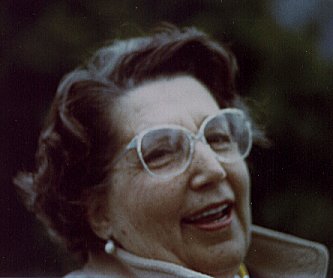 Last June Filomena called me to
postpone an appointment we had in Lugano, Switzerland, because
she felt very tired. Her call was long for we had the usual
exchange of news about the Association, but I would never have
thought that it would be the last time I would hear her dear
voice.
I met Filomena around 1973/74, when I was invited by a very kind
Alumna; she lived near us and I was meeting her at other
"social" occasions. Dear Thea Corradi dal Verme invited
me to tea with the President of the National Alumnae Association,
Filomena Luciani.
In Rome, she had
received from Mother Barcherini the names of Francesca
Melzi-Kaucisvili and myself, recommending that she meet us. I had
not been a pupil of Mother Barcherini, but three of my sisters
were.
In fact, I did not go to
the Genoese RSCJ school for my studies, except for the first
elementary class, with peparation to First Communion and
Confirmation; and then afterwards for three classes of Gymnasium,
interrupted at the Lyceum by bombardments in Autumn 1942.
However, my "Sacred Heart formation" had been prepared
and supervised by my Mother, an unshakable Alumna and Child of
Mary, as it was for all ten of her children.
Later, I lived for 16 years near Leghorn and I could not go to
Florence for the Association - but when I arrived in Milan I went
to Via San Vittore with pleasure and met many Alumnae and
Children of Mary of various towns. I was warmly welcomed.
In those years when
protest movements were so active, I was a teacher and I had to
dedicate all my time to seminars on new ideas, helped by the
Catholic Teachers' Association, and therefore I neglected the
Sacred Heart Alumnae.
My meeting with Filomena
was a fateful moment for me and, I think, also for Francesca.
From then on, we became active within the Association in San
Vittore and we took part in the National and European Congress of
1975, thus beginning our national and international
"careers".
I think - and I believe I speak also for Francesca - that
Filomena's advice was very important in all we did, as it surely
was for Beatriz Salazar: who called Filomena "my
crooked-minded advocate".
I am sure you can all
understand why I am so thankful and moved while I write what
follows. I have divided these memories into three chapters:
1 -
Filomena as a Sacred Heart Alumna
2 - Her religious and socio-political commitment
3 - Her family and cultural life
1 - Filomena
as a Sacred Heart Alumna
There are other friends
of Filomena's who could tell you about her activities in both the
Roman and Italian Associations, well before I began to be
actively involved.
I know for certain that she worked intensely beside the Foundress
of the movement, Maria Theodoli, and that she participated in
drawing up the statutes of the first national constitution, as
well as all the other initiatives of those years.
She was President of UNIEASC before Ina Majorana and took part in
national and world Congresses ("Rassemblements" or
Assemblies as they were called then) and she spoke to me of many
events and memories.
She visited all the Italian Associations. Everywhere she went,
she tried to recreate the same spirit of engagement and
enthusiasm which she lived.
I remember her in Rome (Italian and European Congress in 1975 at
"Le Frattocchie") and then in the following Italian
Congresses: in Milan (Ina Majorana was Italian President and I
was President of the Milan Association); in Rome (1979): in Padua
(1981, she presented the new Italian Constitution she had
prepared); in Genoa (1983) and in Rome (1985) etc.
She was always alert and attentive, the significance of her work
and presence sometimes concealed behind her great sense of
humour.
With Mother Caracciolo, Filomena visited the RSCJ Schools and
Alumnae Associations in America. The impact of this contact with
a reality which was so different, and yet in some ways so
familiar, opened new horizons for our Alumnae and Religious, as
well as the Italian and World Associations.
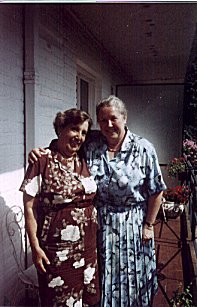 Her work for the World Association was
very important. From the very first "Assemblies" in
Rome and Brussels she worked closely with AMASC's founders; her
legal competence helped form the first Constitution.
She worked as Advisor on
the 1966 Statutes and those of 1974 were actually prepared at her
home in Salto di Fondi!
Finally, with Denise
Peeters and Jacqueline Klomp-Verhoeven, she prepared the statutes
of the most recent Constitution; these were approved in San Luis
Potosí in March 1998. At the end of the session, the newly
elected President, Trish Burns, declared Filomena officially
included in the list of "Emeritus Members" of AMASC.
In 1970, at Mother
Barcherini's proposal, she took part in a session of the Chapter
of the Society of the Sacred Heart along with nine other Alumnae
from all the continents, and in 1976 at the next Chapter she gave
a speech on the political engagement of Christians. I have kept a
copy of this speech.
From 1972 to 1978 she
was "Liaison Permanente avec la Maison Mère"
(Permanent Liaison with the Mother House) and from 1980 to 1994
she was the much appreciated AMASC Archivist.
Her position within our national and world Associations drew her
easily into other world Associations: delegate to
"Commission d'entente et d'études" to constitute
OMAAEEC, then Vice President of CONFEDEREX, Secretary to the
OMAAEEC President and from 1973 Archivist also of that
Association.
2 - Her
religious and socio-political commitment
Filomena's activity within her Parish and Diocese was constant
and valuable. She helped to prepare the Congress of the Roman
Diocese on "Expectations of Justice and Charity". She
was diocesan secretary for the central Roman area and a member of
the diocesan Caritas Welcome Centre.
I remember once she had
to postpone an Association meeting with us because of her
engagement during a pastoral visit. I remember above all how her
work was tied to her social and political activities. She always
said that her religious formation compelled her to be present in
the world.
That was certainly why, in far-off 1943, during the war and
Allied advance into southern Italy, she joined women of all
political persuasions to form the U.D.I. (Italian Women's Union).
However, she resigned when the union began to take a single party
political line. Her idea was to unite women in a movement
stressing their capacities but also their rights.
Because of this
commitment she was asked by the Allied Forces to create C.A.F.
(Corpo Ausiliario Femminile) within the Italian Army - this corps
was similar to the W.A.C.s. Its purpose was to help Italian
soldiers who were gradually joining the Allies. Filomena attained
the rank of Major and she is cited in the last volume of the
Italian Treccani Encylopedia. Some Generals, journalists and
government Ministers have since denied or ignored the existence
of this corps and Filomena responded with well-documented
rebuttals. One of the purposes of the group was to provide
assistance to soldiers returning from Yugoslavia. These soldiers
were imprisoned by the Allies in concentration camps, behind
barbed wire, because they were thought to be dangerous communist
sympathisers, when in fact they had actually fought against them.
Filomena's mediation helped prevent irreparable misunderstandings
and divisions.
Another task she
performed with competence and enthusiasm was to help to
constitute the "District Committees" where she worked
with people of very different ages and backgrounds, e.g.
Innocenzo Cipolletta, now General Manager of Confindustria, (the
Italian Confederation of Industries).
For many years she also
worked on the radio series "Room F - call Rome 3131",
the first live talkback program where women could ask for answers
to pressing questions by phone. Cardinal Poletti asked her to
participate in this broadcast, since she was well qualified to
answer legal questions, but above all because he trusted her
moral strength. He was also sure she that her responses would be
quick and lively, even to complicated questions.
I know she received a letter of thanks and appreciation from the
Cardinal.
3 - Her
family and cultural life
Her capacities were truly amazing. Because of her formation and
her beliefs, it is not surprising that she cared so well for her
family, both her birth family and the one she built with Giorgio
- their 4 sons and their many grandchildren. She took care of
everyone, calmly but with great efficiency. For example, she once
took a grandchild into her home to help him with a difficult
period in his education.
These responsibilities
could not prevent her - in fact they seemed to stimulate her -
from being much involved in several cultural fields: literature,
art, theatre, cinema. She had several relatives working
successfully in those fields. One had only to see the quantity
and quality of the books and paintings at her home in Via
Nazionale, or hear her speak of theatre, painting, Italian or
Australian films... to realise that she really was an expert in
so many areas.
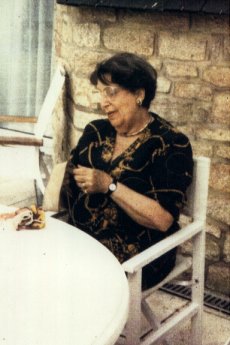 A young Florentine student of literature
has used her many letters to Jaime Pintor as the basis for her
degree thesis; in the coming months these will be published (I
think by Einaudi) not only as a very special literary document
but also as a chronicle of a time when young people's interests
and feelings were so different from what they are today.
She had what we call
"mani d'oro" in Italian - "golden hands". You
might have seen the carpets she made in "petit-point",
or found the results of her embroideries and her fantasy in
charity bazaars.
That's why her home was as pleasant and happy as she was. She was
always ready to welcome friends at her table or offer her famous
"5-star" hospitality.
A special chapter could
be written on her preparation for the "Befana" (January
6th, an Italian holiday), when she gathered together not only
family but also friends. There were gifts for everybody, prepared
well in advance with love and care and much thought for tastes,
wishes, usefulness.
With the same care and
the same love she left a list of valuables to be left to
relatives, even thinking of someone's future wedding!
I don't think even this
long discourse is complete or exhaustive; but as a final
brushstroke on this portrait, I will tell you something Giorgio
passed on to me. Among the papers found after her death, there
was an envelope which contained the text of the liturgy she had
chosen for her funeral.
This was typical of a
person who was always ready to act and to commit, but always with
one end: the final, true and important Goal of all her life.
- MARIA
FRANCA MIGONE